
Attention Mask
앞으로 죽도록 들을 Attention Mask를 한번 정리한다. 용도(패딩, causal, VLA 블록 규칙), 1D pad/att mask를 cumsum으로 2D로 만드는 make_att_2d_masks, 그리고 softmax 직전에 어떻게 쓰이는지까지 SmolVLA 코드로 확인한다.
Attention Mask라는 개념을 이제 사실 죽도록 들을 것이기 때문에, 이 시간에는 한번 정리를 해보자 정확하게 용도는 무엇이며 코드로 어떻게 생성하고 사용하는지.
Contents
- 용도
- 생성 코드
- 사용 코드
Purpose
일단 어텐션의 핵심은 Query, Key, Value이다.
즉 내가 다음 토큰을 예측할때, 결국에 이전 토큰들을 참고하고 어느정도 참고해야할 지를 학습하는 것이다. 그렇다면 참고해야할 토큰이 있고 아닌 토큰이 있는 경우가 발생한다.
예를들어보자,
1) 패딩 토큰
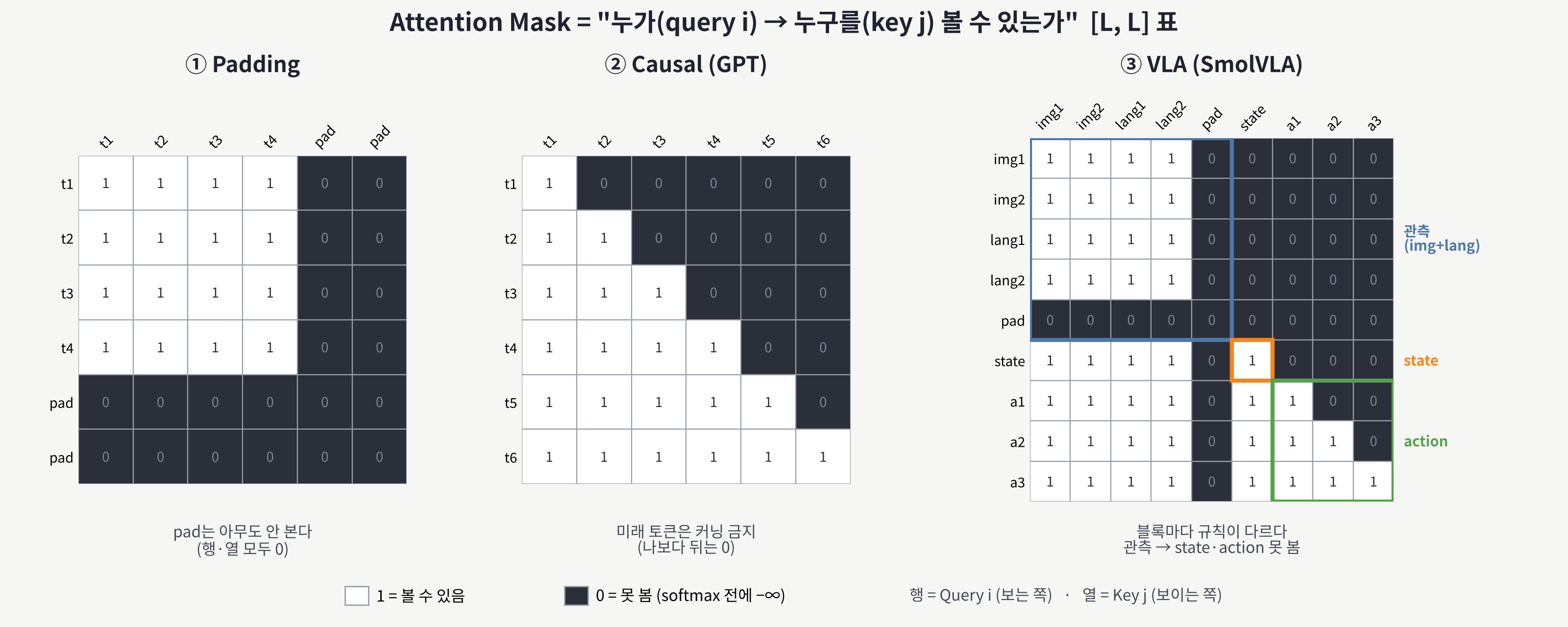
문장 길이를 48로 맞추려고 뒤에 채워 넣은 빈칸(pad)이다. 아무 의미도 없는 토큰이니까 누구도 참고하면 안 된다.
2) 미래 토큰 (GPT)
다음 토큰을 예측하는데 이미 정답(미래 토큰)을 볼 수 있으면? 그냥 커닝이다 ㅋㅋ 그래서 나보다 뒤에 있는 토큰은 못 보게 막아야 한다. 이게 바로 Causal Mask.
3) VLA (SmolVLA)
여기서 좀 재밌어진다. 블록마다 규칙이 다르다.
- image + language: 관측끼리는 서로 다 봐야 한다 (full)
- state: 관측은 볼 수 있지만, 관측은 state를 못 본다 (새 블록)
- action: 관측을 전부 봐야 한다. 하지만 관측은 action을 보면 안 된다 → 추론 때 prefix를 액션 없이 먼저 돌려서 KV cache로 만들어두기 때문에, 학습 때도 똑같이 막아줘야 한다.
결국 Attention Mask = “누가(query i) → 누구를(key j) 볼 수 있는가” 를 적어둔
[L, L]표이다.
1 = 볼 수 있음, 0 = 못 봄. 행이 query, 열이 key.
실제로 SmolVLA prefix(241개 토큰)의 mask를 뽑아보면 다음과 같다. (흰색 = 볼 수 있음)
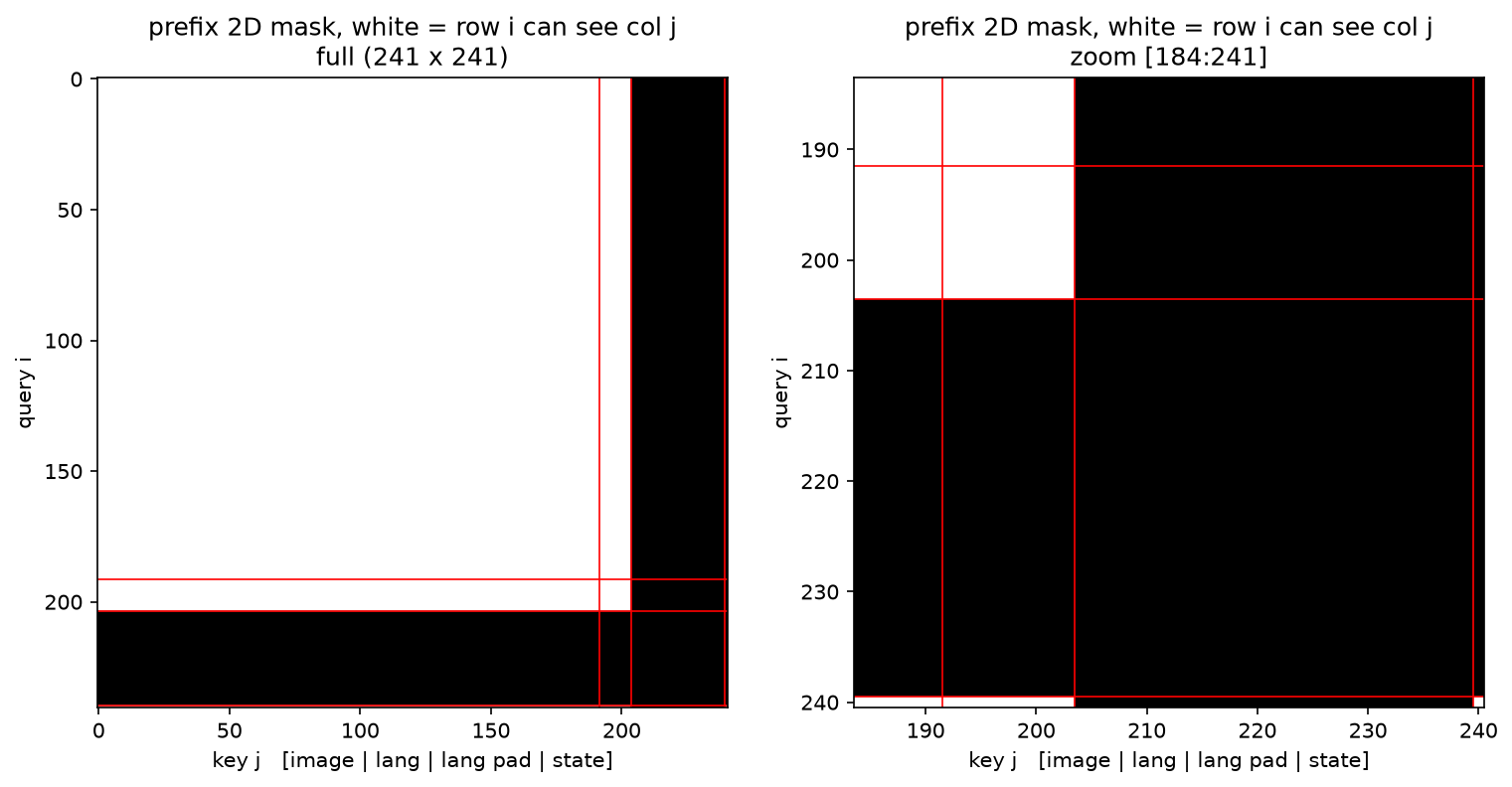
- 왼쪽 위 큰 흰 사각형: image + language끼리 full attention
- 검은 띠: language padding (행도 열도 전부 0)
- 맨 아래 한 줄(state): 앞의 관측은 다 보지만, 위의 관측 행들은 state 열을 못 본다
make_att_2d_masks
1
2
3
4
5
6
7
8
9
10
11
12
13
14
15
16
17
18
19
20
21
22
23
24
25
26
27
28
29
30
def make_att_2d_masks(pad_masks: Tensor, att_masks: Tensor) -> Tensor:  # see openpi (exact copy)
    """Copied from big_vision.

    Tokens can attend to valid inputs tokens which have a cumulative mask_ar
    smaller or equal to theirs. This way `mask_ar` int[B, N] can be used to
    setup several types of attention, for example:

      [[1 1 1 1 1 1]]: pure causal attention.

      [[0 0 0 1 1 1]]: prefix-lm attention. The first 3 tokens can attend between
          themselves and the last 3 tokens have a causal attention. The first
          entry could also be a 1 without changing behaviour.

      [[1 0 1 0 1 0 0 1 0 0]]: causal attention between 4 blocks. Tokens of a
          block can attend all previous blocks and all tokens on the same block.

    Args:
      input_mask: bool[B, N] true if its part of the input, false if padding.
      mask_ar: int32[B, N] mask that's 1 where previous tokens cannot depend on
        it and 0 where it shares the same attention mask as the previous token.
    """
    if att_masks.ndim != 2:
        raise ValueError(att_masks.ndim)
    if pad_masks.ndim != 2:
        raise ValueError(pad_masks.ndim)

    cumsum = torch.cumsum(att_masks, dim=1)
    att_2d_masks = cumsum[:, None, :] <= cumsum[:, :, None]
    pad_2d_masks = pad_masks[:, None, :] * pad_masks[:, :, None]
    return att_2d_masks & pad_2d_masks
생각보다 코드는 단순하다. 핵심은 cumsum 에 있다.
pad_masks = 1D
att_masks = 1D
이 두친구들을 가지고 이제 2d 로 조합하는게 이 코드의 목적이다.
att_masks 1D의 의미: 블록 경계 표시
처음에 이게 제일 헷갈렸는데, att_masks는 “보인다/안 보인다”가 아니라 블록 경계를 적어둔 것이다.
- 0 = 앞 토큰이랑 같은 블록 (cumsum 그대로)
- 1 = 여기서 새 블록 시작 (cumsum +1) → 앞 토큰들은 나를 못 본다
그리고 규칙은 딱 한 줄이다.
\[\text{att\_2d}[i, j] = \text{cumsum}[j] \le \text{cumsum}[i]\]말로 하면 “나보다 뒤 블록은 못 본다”
pad는 att랑 상관없이 pad[i] * pad[j] 로 행, 열 둘 다 0이 된다.
손으로 한번 풀어보자
image 4개를 한 블록, state 3개를 causal로 두고 싶다면,
1
2
3
4
5
6
7
8
9
10
11
12
tokens = [img1, img2, img3, img4, s1, s2, s3]
att    = [0,    0,    0,    0,    1,  1,  1]
cumsum = [0,    0,    0,    0,    1,  2,  3]

# att_2d[i, j] = cumsum[j] <= cumsum[i]
[1, 1, 1, 1, 0, 0, 0]
[1, 1, 1, 1, 0, 0, 0]
[1, 1, 1, 1, 0, 0, 0]
[1, 1, 1, 1, 0, 0, 0]   # image 1~4: 서로 full attention
[1, 1, 1, 1, 1, 0, 0]   # s1
[1, 1, 1, 1, 1, 1, 0]   # s2
[1, 1, 1, 1, 1, 1, 1]   # s3  -> state 끼리는 causal
실제로 메서드를 호출해보니 한 칸도 안 틀리고 똑같이 나왔다.
실습 코드
직접 make_att_2d_masks를 호출해서 4가지 패턴을 그려보자. (phase1_smolvla/03_mask_practice.py)
1
2
3
4
5
6
7
8
9
10
11
12
from pathlib import Path
import torch
import matplotlib.pyplot as plt
from lerobot.policies.smolvla.modeling_smolvla import make_att_2d_masks

# (tokens, pad_masks, att_masks)
cases = {
    "my example":       (["img1","img2","img3","img4","s1","s2","s3"], [1,1,1,1,1,1,1], [0,0,0,0,1,1,1]),
    "smolvla prefix":   (["img1","img2","lang1","lang2","pad","state"], [1,1,1,1,0,1],  [0,0,0,0,0,1]),
    "full (all zeros)": (["t1","t2","t3","t4","pad"],                  [1,1,1,1,0],    [0,0,0,0,0]),
    "smolvla suffix":   (["a1","a2","a3","a4","a5"],                    [1,1,1,1,1],    [1,1,1,1,1]),
}
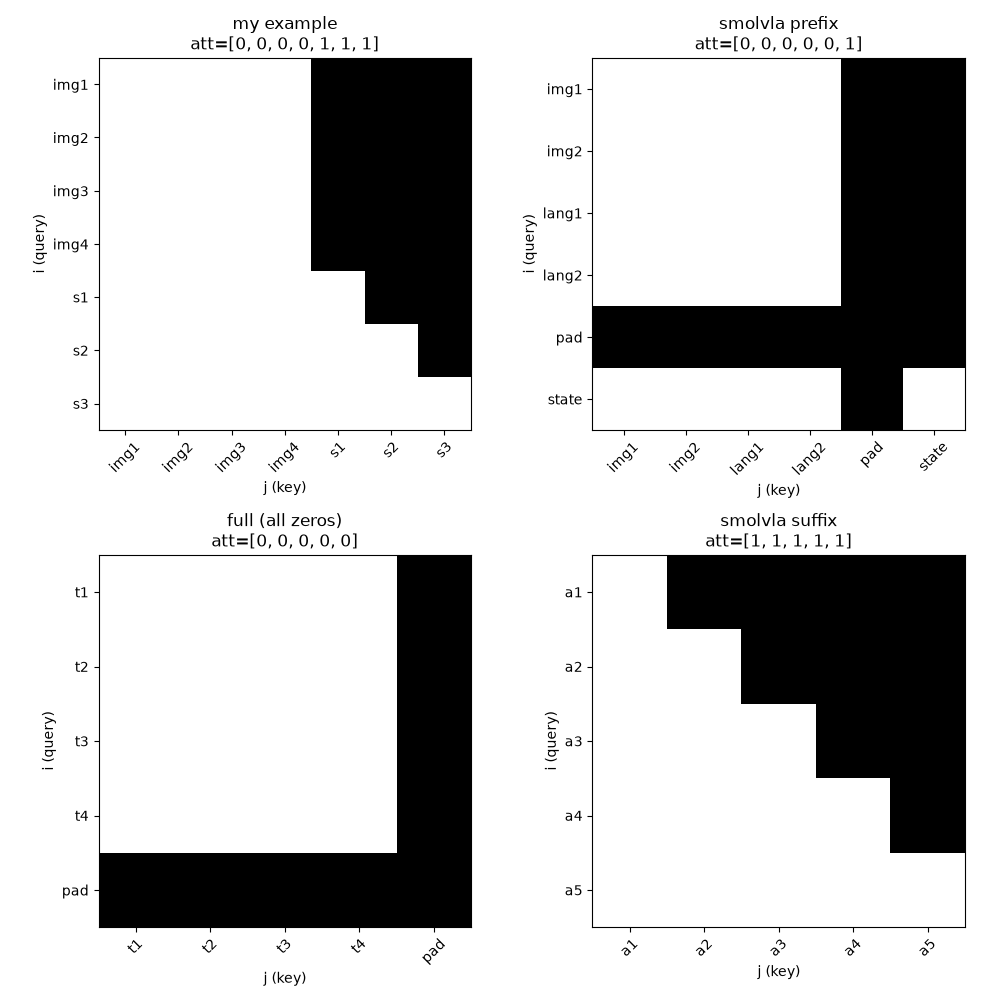
[0,0,0,0]→ full (BERT처럼 양방향)
-[1,1,1,1]→ causal (GPT)
-[0,0,1,1]→ prefix-LM: 앞 블록은 full, 뒤는 causal
- 맨 앞 값은 0이든 1이든 결과가 같다 (앞에 아무도 없으니까)
→ 결국 1D 리스트 하나로 블록 구조 전체를 표현하는 것이다.
사용 코드
그럼 만든 mask는 어디서 쓰일까? 결국 softmax 직전에 쓰인다.
1) Attention 안에서: 못 보는 칸을 -∞로
1
2
3
4
5
6
7
8
# lerobot -> policies -> smolvla -> smolvlm_with_expert.py  (eager_attention_forward)

att_weights = torch.matmul(query_states, key_states.transpose(2, 3))   # [B, H, L_q, L_k]
att_weights *= head_dim**-0.5

big_neg = torch.finfo(att_weights.dtype).min                           # 사실상 -inf
masked_att_weights = torch.where(attention_mask[:, None, :, :], att_weights, big_neg)
probs = nn.functional.softmax(masked_att_weights, dim=-1)              # 0인 칸 -> 확률 0
- mask가 1인 칸은 점수 그대로, 0인 칸은 엄청 큰 음수로 바꿔버린다.
- softmax에서 $e^{-\infty} = 0$ 이니까 그 토큰은 확률 0 = 아예 안 본 것이 된다.
[:, None, :, :]는 head 축을 추가해서 15개 head 전부에 같은 mask를 쓰려는 것.- 그럼 왜 진짜 -inf가 아니라
finfo.min(엄청 큰 음수)을 쓸까? padding 행처럼 한 줄 전체가 0인 경우가 있기 때문이다. 전부 -inf면 softmax가 0/0 = NaN이 되어버린다. 엄청 큰 음수를 쓰면 이런 행도 NaN 없이 그냥 균등분포로 끝난다. (어차피 padding 행의 결과는 안 쓴다)
2) SmolVLA에서 쓰이는 곳 2군데
(a) Prefix prefill (KV cache 만들 때): 정사각형 [B, L_p, L_p] = [1, 241, 241]
1
2
prefix_embs, prefix_pad_masks, prefix_att_masks = model.embed_prefix(images, img_masks, lang_tokens, lang_masks, state=state)
prefix_att_2d_masks = make_att_2d_masks(prefix_pad_masks, prefix_att_masks)    # [1, 241, 241]
(b) Denoise step: 직사각형 [B, L_s, L_p + L_s] = [1, 50, 291]
1
2
3
4
5
6
# action(query 50개) -> prefix(cache 241개): 진짜 토큰이면 전부 봄
prefix_pad_2d_masks = prefix_pad_masks[:, None, :].expand(batch_size, suffix_len, prefix_len)   # [1, 50, 241]
# action -> action: causal
suffix_att_2d_masks = make_att_2d_masks(suffix_pad_masks, suffix_att_masks)                      # [1, 50, 50]
# key 축(dim=2)으로 이어붙이기
full_att_2d_masks = torch.cat([prefix_pad_2d_masks, suffix_att_2d_masks], dim=2)               # [1, 50, 291]
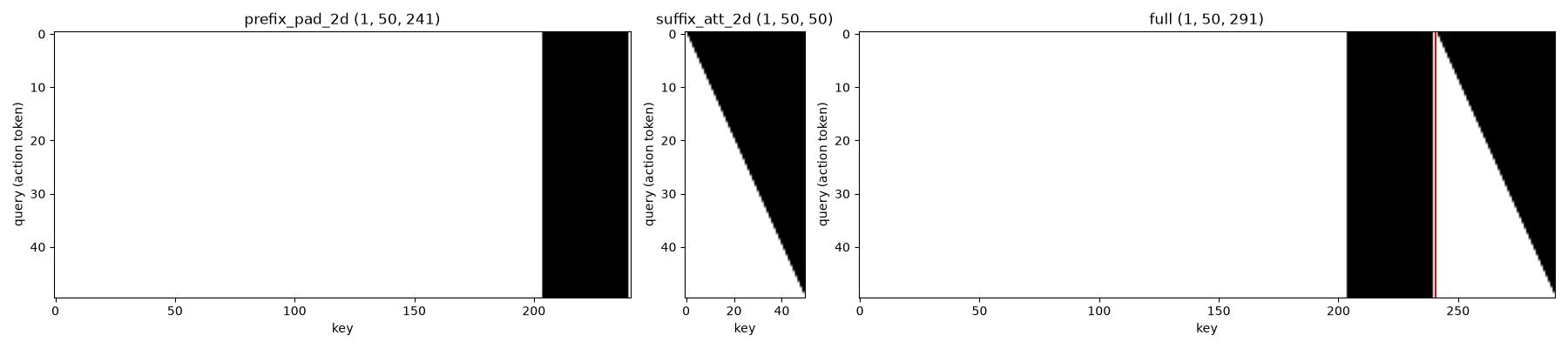
- 빨간 선 왼쪽: KV cache(prefix 241), 오른쪽: 새로 들어온 action 50
- denoise 때는 action만 query로 들어오니까 정사각형이 아니라 50 x 291 직사각형이 된다.
정리하면, 1D 두 개(pad, att)로 블록 규칙을 적고 →
make_att_2d_masks로 [L, L] 표를 만들고 → softmax 직전에 0인 칸을 -∞로 지워버린다. 이 세 단계가 mask의 전부다.